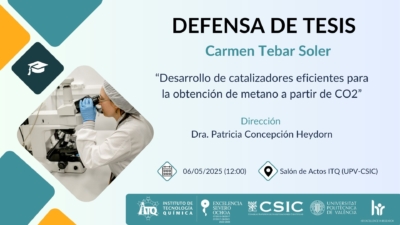
Tesis: Valorización del 5-hidroximetilfurfural en compuestos de química fina mediante reacciones en cascada utilizando nanopartículas metálicas – Beatriz Hurtado Cebrián

Beatriz Hurtado Cebrián defenderá su tesis doctoral “Valorización del 5-hidroximetilfurfural en compuestos de química fina mediante reacciones en cascada utilizando nanopartículas metálicas” el próximo jueves 23 de enero de 2025, a las 12:00h, en el Salón de Actos del ITQ (UPV-CSIC).


Más información

Director/a: Sara Iborra Chornet; María José Climent Olmedo; Karen Sulay Arias Carrascal

Programa de doctorado: Programa de Doctorat en Química Sostenible

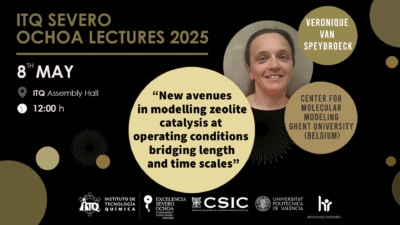
ITQ Severo Ochoa Lecture «Recent Advances in Zeolite Synthesis and Catalysis at CONS» – Suk Bong Hong

El viernes 17 de enero de 2025 tendrá lugar la jornada ITQ Severo Ochoa Lecture «Recent Advances in Zeolite Synthesis and Catalysis at CONS» a las 12h en el Salón de Actos del ITQ (UPV-CSIC).

Esta jornada la imparte Suk Bong Hong, Center for Ordered Nanoporous Materials Synthesis (CONS), Division of Environmental Science and Engineering, POSTECH, Korea.


Recent Advances in Zeolite Synthesis and Catalysis at CONS

Owing to their unique shape- and surface-selective properties, zeolites and zeolite-like materials continue to expand their commercial applications in traditional areas, i.e., catalysis and separations, as well as in emerging areas ranging from microelectronics to medical diagnosis. This is largely due to the discovery of new zeolite structures and compositions constantly achieved over more than a half century.

In this talk, I will describe the multiple inorganic cation and excess fluoride approaches in the synthesis of new zeolite structures, which has been developed in my own group at POSTECH over the last decade. These two approaches, which aim to promote a synergistic cooperation between inorganic and organic structure-directing agents and thus to hold a rational design concept, have allowed my group to discover more than ten novel structures (e.g., PST-2 (POSTECH no. 2; SBS/SBT intergrowth), PST-6 (framework type PSI), ZSM-25 (MWF), PST-14 (POR), PST-20, PST-21 (PWO), PST-22 (PWW), PST-24, PST-29 (PWN), PST-30 (PTY), PST-31 (PTO), etc.), as well as many unprecedented compositions (high-silica LTA, GIS, MER, and PHI zeolites, PST-32 (SBT), etc.). I will also discuss recent advances in zeolite catalysis on three reactions: NH3-SCR, wet methane combustion, and monomethylamine synthesis.

ITQ Inspire Lab. De la idea a la propuesta: navegando Horizonte Europa

Empezamos 2025 con una nueva sesión de ITQ Inspire Lab. De la idea a la propuesta: navegando Horizonte Europa.

La jornada se celebrará el próximo 15 de enero de 2025 en el Salón de actos del ITQ en horario de 09:50h a 13.30h.

En esta ocasión la jornada está centrada en conocer los puntos clave del programa Horizonte Europa, así como conseguir que las propuestas presentadas lleguen a buen puerto. Para ello contaremos con la colaboración de los compañeros/as del servicio CPI Europe de apoyo a la participación de la UPV en Horizon Europe: Ana-Cruz García Belenguer, Directora; Jessica Castillo Rodríguez, Programme Manager; Miguel Pizá Padial, Project Designer, así como con Emma Burgos, Técnica de internacionalización en el ITQ.

Una vez finalizada la jornada, después de la pausa para comer, se realizarán reuniones bilaterales entre las personas del ITQ que lo soliciten y los expertos de CPI Europe. En estas reuniones se podrán resolver dudas y plantear preguntas sobre la presentación de propuestas a Horizonte Europa y los servicios que CPI Europe puede ofrecer a los grupos de investigación del ITQ (tanto investigadores UPV como CSIC). Estas reuniones se realizarán en la Sala de Reuniones de la 2ª planta del ITQ.

La jornada ha sido organizada desde Excelencia Severo Ochoa del ITQ (UPV-CSIC), el Área de Proyectos Europeos del ITQ y CPI Europe de la UPV y va dirigida a todo el personal investigador y en formación que esté interesado en asistir.

¡Os esperamos!

Tesis: Advanced electron diffraction techniques for structural elucidation of microporous materials – Juan Ignacio Tirado Castaño

Juan Ignacio Tirado Castaño defenderá su tesis doctoral “Advanced electron diffraction techniques for structural elucidation of microporous materials” el próximo lunes 13 de enero de 2025, a las 11:30h a.m., en el Salón de Actos del ITQ (UPV-CSIC).


Más información

Director/a: Jose Luis Jorda Moret y Partha Pratim Das

Tutor/a: Sara Iborra Chornet

Programa de doctorado: Programa de Doctorado en Química Sostenible


Tesis: Novel heterogenous catalysts for the selective hydrogenation of CO2 to CH4 – Raúl Bruno Machado Da Silva

Raúl Bruno Machado Da Silva defenderá su tesis doctoral «Novel heterogenous catalysts for the selective hydrogenation of CO2 to CH4» el próximo miércoles 11 de diciembre de 2024 a las 11:30h en el Salón de Actos del ITQ (UPV-CSIC).

Más información

Director: Antonio Chica Lara
Tutor: Sara Iborra Chornet
Doctoral programme: PhD in Sustainable Chemistry
Research team: Catálisis Heterogénea y combustibles limpios a partir de fuentes alternativas al petróleo

ITQ Talks: Accelerated Design of Functional Materials: Overcoming the “Valley of Death” in Heterogeneous Catalysis – Prof. Ambarish Kulkarni

Os esperamos en una nueva edición de ITQ Talks!

En esta jornada contaremos con Prof. Ambarish Kulkarni quien impartirá la charla «Accelerated Design of Functional Materials: Overcoming the ‘Valley of Death’ in Heterogeneous Catalysis«.

Esta edición de ITQ Talks se realizará el 9 de diciembre de 2024 a las 11h a.m. en el Salón de Actos del ITQ (UPV-CSIC).

CV Prof. Ambarish Kulkarni

Ambar Kulkarni is an Associate Professor in the Department of Chemical Engineering at UC Davis. After receiving his B.S. from the Institute of Chemical Technology (formerly UDCT), Mumbai (India), he moved to the U.S. to complete his Ph.D. (Georgia Tech, with David Sholl) and postdoc (Stanford, with Jens Nørskov). Since 2018, his research group has focused on combining advances in multiscale molecular modeling and machine learning with multifaceted experimental collaborations to address the challenges in catalysis, separations, and chemical sensing. His research group has experience with a variety of functional materials (e.g., zeolites, metal-organic frameworks (MOFs), metals, oxides), simulation methodologies, and automated analyses of experimental results (e.g., X-ray absorption spectroscopy, NMR spectroscopy, surface-enhanced Raman spectroscopy). Research in the Kulkarni group is supported through grants from the National Science Foundation (NSF), the Department of Energy (DOE),and several industry partnerships.

Kulkarni’s interdisciplinary research and teaching were recognized with the UC Davis College of Engineering Outstanding Junior Faculty Award for Excellence in Research and UC Davis College of Engineering Best Teaching Award in 2021. He received a 2021 NSF CAREER award for his work in designing MOFs for electrochemical applications. As the Inaugural UC Davis Graduate Mentor Fellow (2020 – present), Kulkarni has developed a series of mentorship workshops for UC Davis faculty aimed at improving the graduate student mentorship experience. When he is not staring at molecules on the computer screen, Ambar and his wife enjoy traveling to different countries, snowboarding, and photography.

Accelerated Design of Functional Materials: Overcoming the “Valley of Death” in Heterogeneous Catalysis

The democratization of machine learning (ML), the advent of open-access data repositories, and access to growing supercomputing resources are revolutionizing the fields of materials science and heterogeneous catalysis. These advances have enabled high-throughput screening of catalyst libraries at unprecedented scales. However, compared to numerous reports of in-silico discoveries of novel catalysts for various reactions, the anticipated acceleration in lab-scale synthesis and testing, pilot-scale validation, and downstream development of novel processes have been relatively lackluster. In light of the growing severity of the climate change crisis and the changing national security landscape, there is an urgent need to bridge the gap between the computational discovery, experimental realization, and scale-up of promising catalysts.

The overarching goal of this seminar is to illustrate how an interdisciplinary and team-oriented approach can be used to address key challenges within the heterogeneous catalysis community. Using examples spanning zeolites, metal-organic frameworks and supported oxide catalysts, this talk will illustrate (1) the capabilities and limitations of the current computational methods, (2) the unique insights provided by theory (used in close collaboration with experiments), and (3) the central role of software development, data engineering, and robotics as enablers for ML-based materials development pipelines. Taken together, this talk will present a cohesive vision for the expanding role of theory and data science (used judiciously in conjunction with experimentation) to accelerate innovations in emerging technologies that rely on the development of functional materials.

Tesis: Bifunctional and nanospatial effects in copper catalysts for methanol synthesis – Iván López Luque

Iván López Luque defenderá su tesis doctoral “Bifunctional and nanospatial effects in copper catalysts for methanol synthesis” el próximo martes 3 de diciembre de 2024 a las 11:00h en el Salón de Actos del ITQ (UPV-CSIC).


Más información

Director: Gonzalo Prieto González

Tutor: María José Climent Olmedo

Doctoral programme: PhD in Sustainable Chemistry

Research team: Catálisis Heterogénea y combustibles limpios a partir de fuentes alternativas al petróleo

ITQ Talks: Templated Synthesis of Single-Site Electrocatalysts with Microporous Materials – Dr. Jesús Barrio Hermida

Os esperamos en una nueva edición de ITQ Talks!

En esta ocasión contamos con el Dr. Jesús Barrio Hermida quien impartirá la charla «Templated Synthesis of Single-Site Electrocatalysts with Microporous Materials».

La jornada se realizará el 21 de noviembre de 2024 a las 12:00h p.m. en el Salón de Actos del ITQ (UPV-CSIC).

CV breve Dr. Jesús Barrio Hermida

Jesús Barrio Hermida received his Bachelor of Science in Chemistry from the Universidad Autónoma de Madrid (Madrid, Spain) in 2014, and his Master in Nanoscience and Molecular Nanotechnology from the same institution in 2016. He moved to the Max Planck Institute for Colloids and Interfaces (Potsdam, Germany) for pursuing his doctoral studies, and in September 2016, he joined the Ben-Gurion University of the Negev (Beer-Sheva, Israel) along with his PhD supervisor, Prof. Menny Shalom, where he obtained his PhD in May 2020. His doctoral thesis focused on the design of metal-free carbon nitride materials for photo-electrocatalytic applications. During his PhD, Jesús received the Israel Chemical Society award for Graduate Students in 2018 and the Kreitman Rector Prize of the Faculty of Natural Sciences in 2019.

In June 2020 he joined the Materials Department at Imperial College London as a Research Associate to work along with Dr. Ifan Stephens and Prof. Magda Titirici where he developed a research line focused on carbon-based materials for fuel cells and carbon dioxide conversion. In 2023, he received the Young Investigator Award by the Spanish Royal Society of Chemistry and was awarded an Imperial College Research Fellowship to start his independent career at the Chemical Engineering Department, where his group now studies the design and synthesis of single atom electrocatalysts for sustainable energy technologies.

Más información sobre el contenido de la charla clicando aquí.

ITQ Inspire Lab. Opening the Editor’s Black Box

El próximo 20 de noviembre de 2024 vuelve una nueva edición de ITQ Inspire Lab: Opening the Editor’s Black Box. En esta ocasión contaremos con Dr. Sandra González Gallardo, Editora en Jefe de ChemCatChem y Editora en Jefe Adjunta de The European Journal of Inorganic Chemistry.

El ITQ Inspire Lab se realizará en el Salón de Actos del ITQ (UPV-CSIC) en horario de 11:30h a.m. a 13:30h pm.

La jornada se dividirá en 3 partes:

«Insider Tips for Successful Submissions and Open Access Publishing»

  •  Está dirigida a investigadores con relativa poca experiencia en la preparación de manuscritos científicos (PhDs, postdocs, early-career researchers). En esta charla se incluye también una perspectiva sobre las ventajas de publicar en acceso abierto y las opciones disponibles.

«The Peer Review Process and Beyond»

  • Da detalles acerca de la evaluación inicial de los manuscritos por parte del editor, así como el proceso de selección de revisores expertos y toma de decisiones editoriales y sus posibles resultados. Por ello, este seminario se recomienda principalmente para personal investigador con experiencia directa en el uso de plataformas de envío de manuscritos a evaluación. En esta charla también se incluyen algunas recomendaciones sobre medios para aumentar la visibilidad de las publicaciones propias.

«Current Trends and Challenges in Scientific Publishing»

  • Incluye temas de mucha relevancia actualmente en el campo de la ciencia y la publicación de resultados científicos. Se tocan temas como la identificación de revistas/editoriales depredadoras, el uso de herramientas de inteligencia artificial y los retos actuales que enfrenta la ciencia, relacionados con malas prácticas científicas y de publicación. Esta sesión menciona algunos contenidos que se cubren más detalladamente en las dos charlas anteriores y está pensada como una sesión interactiva, con información esencial por parte de la ponente, para dar oportunidad a la audiencia de hacer preguntas e iniciar debates.

Dr. Sandra González Gallardo

Sandra González Gallardo es egresada de la licenciatura en Química de la Universidad Nacional Autónoma de México. Después de haber obtenido el título de Doctora en Ciencias con especialidad en Química Inorgánica en el Instituto de Química (UNAM), emigró a Alemania como becaria postdoctoral del Servicio de Intercambio Académico Alemán (DAAD).

Tras seis años de experiencia como investigadora y docente en instituciones universitarias alemanas, inició en 2016 su carrera en Wiley como editora de revistas científicas de Chemistry Europe. Actualmente, Sandra González es Editora Jefe de ChemCatChem y Editora Jefe Adjunta de The European Journal of Inorganic Chemistry. A partir de enero de 2025, también tomará el cargo de Editora Jefe de Advanced Synthesis & Catalysis.

Wiley-VCH

Wiley-VCH es una empresa editorial alemana, con sede en Weinheim, que edita textos científicos en diferentes áreas de las ciencias naturales, la ingeniería y la economía. Sus publicaciones periódicas son coeditadas junto a diversas sociedades científicas y van dirigidas a la comunidad científica: investigadores, profesionales y estudiantes de todo el mundo. La difusión de información sobre ciencia, tecnología y economía adopta diversas formas, como libros, revistas científicas, bases de datos, publicaciones y servicios en línea.

ITQ Severo Ochoa Lecture «Revolutionary CO2 Utilization and Storage: Generating H2, Electricity and Carbonates» – Guntae Kim

El lunes 25 de noviembre de 2024 tendrá lugar la charla ITQ Severo Ochoa Lecture «Revolutionary CO2 Utilization and Storage: Generating H2, Electricity and Carbonates» a las 12.00h p.m. en el Salón de Actos del ITQ (UPV-CSIC).

La ITQ Severo Ochoa Lecture la imparte prof. Guntae Kim, Department of Energy Materials and Chemistry, Shanghai Institute of Applied Physics (SINAP), Chinese Academy of Sciences (China).

Revolutionary CO2 Utilization and Storage: Generating H2, Electricity, and Carbonates: 

Carbon emissions are one of the important factors affecting climate change, and CO2 utilization is considered to be the most important way to reduce carbon dioxide in the atmosphere. The research team proposed a groundbreaking concept to convert CO2 into value-added chemical and green energy. This system continuously produces electricity and hydrogen through the dissolution of CO2 in a water-based solution in the manner of thermodynamically spontaneous process for the first time. The inspiration comes from the absorption of CO2 by the ocean, which leads to an increase in ocean acidity. The researchers used this concept to «dissolve» CO2 in water to trigger an electrochemical reaction. When acidity rises, the number of protons increases, and they can attract electrons at a high speed.

Through the idea of dissolving CO2 in water and initiating an electrochemical reaction, an efficient Zn-CO2 system was developed, which can generate electricity and hydrogen while consuming CO2. The system has been operating for more than 1000 hours with no detectable degradation. This system is similar to fuel cells, consisting of a cathode (catalysts), a separation membrane (sodium superionic conductor, Nafion), and an anode (Zinc metal). When CO2 is injected into water, the reaction begins, and the conversion rate of CO2 reaches up to 60%. The electricity, hydrogen gas, carbonates and ZnO were produced at the same time. All productions are environmentally-friendly and useful.