eCOCO2 and LAURELIN, ITQ projects invited to EU event in the framework of Expo 2020 Dubai

eCOCO2 and LAURELIN were selected to be presented as outstanding value H2020 projects that already help to deliver the European Green Deal objectives and climate neutrality.

The event “EU Green Deal – Research and Innovation as a driver towards Climate Neutrality” is a two-day event in Expo 2020 Dubai (October 3rd & 4th 2021). It aims to highlight the EU’s excellence in research and innovation as a tool toward climate neutrality and sustainability, and the EU’s willingness of partner cooperation for achieving this global goal.

The event is organized by the European Commission, and it is hosted at the Sweden Pavilion, Expo 2020 Dubai. The event will host a dedicated EU projects’ Networking Village during October 3rd & 4th 2021 and a high-level workshop on October 4th. The high-level workshop is organised as a hybrid event (live streaming).

MORE INFORMATION

REGISTRATION ONLINE EVENT (live-streaming)

AGENDA

Un equipo mixto con miembros del ITQ (UPV-CSIC), publican un estudio que demuestra la efectividad de la ozonización como un proceso de desinfección válido frente al SARS-CoV-2 y otros virus en transporte público

Un equipo mixto con miembros del ITQ (UPV-CSIC), la Universitat Jaume I (UJI) de Castelló, Hydrens –spin off de a UJI- y el Instituto de Agroquímica y Tecnología de los Alimentos (IATA-CSIC) acaba de publicar un estudio que demuestra la efectividad de la ozonización como un proceso de desinfección válido frente al SARS-CoV-2 y otros virus en transporte público. El trabajo se ha publicado en la revista Journal of Environmental Chemical Engineering y ha contado también con la colaboración de las empresas valencianas LIC y Vareser.

El equipo de investigadores e investigadoras de Hydrens desarrolló un modelo numérico que estima la concentración de ozono necesaria para cumplir con los criterios de desinfección. Para ello, tiene en cuenta la geometría y volumen del espacio que hay que tratar, el tipo de materiales que se encuentra en su interior y su capacidad para absorber ozono y las características del sistema de impulsión-distribución utilizado.

“Para determinar la cantidad de ozono necesaria, el modelo tiene en cuenta también las “barreras” con las que se puede encontrar el ozono, como los asientos, barras, asideros, etc. y que provocan que el gas se descomponga al chocar contra ellas. Este ozono se pierde, con lo que es necesario también tenerlo en cuenta y sumarlo a la cantidad de gas necesaria para una correcta desinfección. Y es lo que conseguimos con nuestro modelo”, apunta Javier Navarro, investigador del Departamento de Ingeniería Química y Nuclear de la UPV.

Leer noticia


“The future needs the best researchers”: Postdoctoral Junior Leader Fellowships Call 2022. Apply by: 7th October 2021

The Postdoctoral Junior Leader fellowships programme is aimed at hiring excellent researchers, of any nationality, who wish to continue their research career in Spain or Portugal in the STEM area (Science, Technology, Engineering and Mathematics). The objectives of this programme are to foster high-quality, innovative research in Spain and Portugal and to support the best scientific talent by providing them with an attractive, competitive environment in which to conduct excellent research.

Apply by: 7th October 2021

PROGRAMME DESCRIPTION & APPLY


Investigadores del ITQ en colaboración con investigadores del MIT y la Universidad de Estocolmo han publicado en la revista Science, una nueva metodología de síntesis de catalizadores de naturaleza zeolítica

Investigadores del ITQ en colaboración con investigadores del MIT y la Universidad de Estocolmo han publicado en la prestigiosa revista Science una nueva metodología de síntesis de catalizadores de naturaleza zeolítica basado en técnicas de inteligencia artificial. Esta novedosa metodología permite seleccionar racionalmente las moléculas orgánicas adecuadas para dirigir eficientemente la síntesis de zeolitas, permitiendo controlar tanto sus propiedades físico-químicas como reducir costes en la preparación de las mismas, siendo ambos factores clave para maximizar su posible implementación en procesos de interés industrial y/o medioambiental.

Leer artículo


Perovskite, the future of sustainable energy. At the ITQ we focus on novel materials for the development and expansion of photovoltaic energy.

Perovskite, the future of sustainable energy. At the ITQ we focus on novel materials for the development and expansion of photovoltaic energy. The multidisciplinary research group formed by Sonia Remiro Buenamañana, Rocío García Aboal, Pedro Atienzar and Hermenegildo García research new stable hybrid materials to maximize sunlight absorption.

Read more

Nuevo periodo de pre-matrícula del Máster Universitario en Química Sostenible, del 2 al 10 de septiembre

Se ha abierto un nuevo periodo de pre-matrícula del Máster Universitario en Química Sostenible, que tiene como objetivo conseguir que el alumnado sea capaz de desarrollar nuevos procesos  químicos  que sean  eficientes, económicamente  viables  y que  se lleven  a  cabo de  un modo  respetuoso con  el  Medio  Ambiente.

El periodo de preinscripción es del 2 al 10 de septiembre.

Más información:

Química-Sostenible-máster21-22


ITQ researchers take part in the H2020 European project HIGFLY

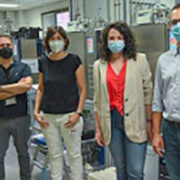
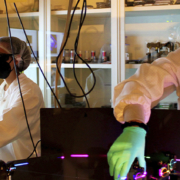
ITQ researchers involved in the HIGFLY project.

ITQ researchers, in cooperation with other European partners, Eindhoven Technical University (TUe, coordinator), TNO, SkyNRG, CSIC, Fraunhofer, Johnson Matthey, Heidelberg Institute for Energy and Environmental Research (IFEU), KNEIA and Boeing, take part in the H2020 Research and Innovation Action HIGFLY.

The major goal of the project is to develop the next generation of technologies for the production of advanced renewable jet fuels from abundant and sustainable biomass feedstocks. In a climate-neutral Europe 2050, flying will remain an important form of mobility. To still be able to meet the strict targets on CO2 emissions of the aviation sector, the use of sustainable aviation fuels in EU, needs to sharply increase up to 2Mton by 2040 (according to IEA). This ambitious target urges the development of novel technologies able to convert abundant and sustainable resources into advanced bio jet fuels cost-effectively. HIGFLY proposed technologies comprise novel, robust and highly efficient catalytic conversions and separation processes for the production of bio-based precursors and jet fuel that will be demonstrated at TRL 3-4. In HIGFLY, second generation biomass, biogenic wastes and biorefinery effluents (i.e. C5 side-streams) will be transformed by means of innovative catalytic reactor technology into furanics and other bio-oxygenated compounds, which after separation will be catalytically condensed and finally upgraded to attain advanced bio-fuels for aviation.

The project will advance the knowledge of its innovative technologies through evaluation of the entire value chain, from feedstock(s) to bio-derived jet-fuel, to demonstrate the advantages of the environmental, social and techno-economic performance of HIGFLY technologies and the prospect of regulatory compliance of HIGFLY’s bio-fuel.

ITQ research team led by Dr. Marcelo E. Domine contributes to the development of novel and robust solid catalysts for the transformation of (C5 enriched sidestreams) biomass feedstocks into furanics and other biooxygenated compounds by working in aqueous medium under mild operation conditions. Additionally, ITQ researchers participate in the downstream catalytic valorization of C1-C4 by-products present in aqueous residual fractions to produce H2 and other products useful for processes integration in HIGFLY.

More information on the project as well as updates on developments and events at the project’s website: https://www.higfly.eu/

This project has received funding from the European Union’s Horizon 2020 research and innovation programme under Grant Agreement no. 101006618.

More information:

HIGFLY-flyerITQ

Fernando Rey, director of the ITQ, has presented the prizes of the Scientific Photography Contest “La ciencia es FantastITQa”

This morning Fernando Rey, director of the ITQ, has delivered the prizes corresponding to the third edition of the Scientific Photography Contest “La Ciencia es FantastITQa”, organized by the ITQ Commission. As we anticipated a few months ago, the first prize has gone to Rocío García Aboal, the second in Ana Moreno Muñoz, and the third in Andrés López García. Congratulations!!

You can find the participating photographs in the link:
https://youtu.be/_i79U-DLapc

Se ha publicado la resolución definitiva de la convocatoria de becas de introducción a la investigación para estudiantes universitarios “JAE Intro ICU”

Disponen de un plazo de 10 días hábiles para enviar la carta de aceptación o renuncia según se indica en la fecha descriptiva.

https://sede.csic.gob.es/intro2021icu

The white paper Clean, Safe and Efficient Energy, coordinated by the researchers José Manuel Serra Alfaro, (ITQ) and Domingo Pérez Coll (ICV) has been published by CSIC

The Clean, Safe and Efficient Energy white paper, coordinated by the researchers José Manuel Serra Alfaro and Domingo Pérez Coll, and in which Antonio Chica Lara has also coordinated a chapter, explores the future energy challenges for a more sustainable world. The impact of conventional energy production technologies on human health and the environment has promoted the development of transition policies towards a new energy sector model. Under this scenario, it is essential to identify the challenges that favor a clean, safe and efficient energy system, focused on energy production and storage systems, as well as on the existing management resources and their emissions.

Read the complete press release

Link to the white book