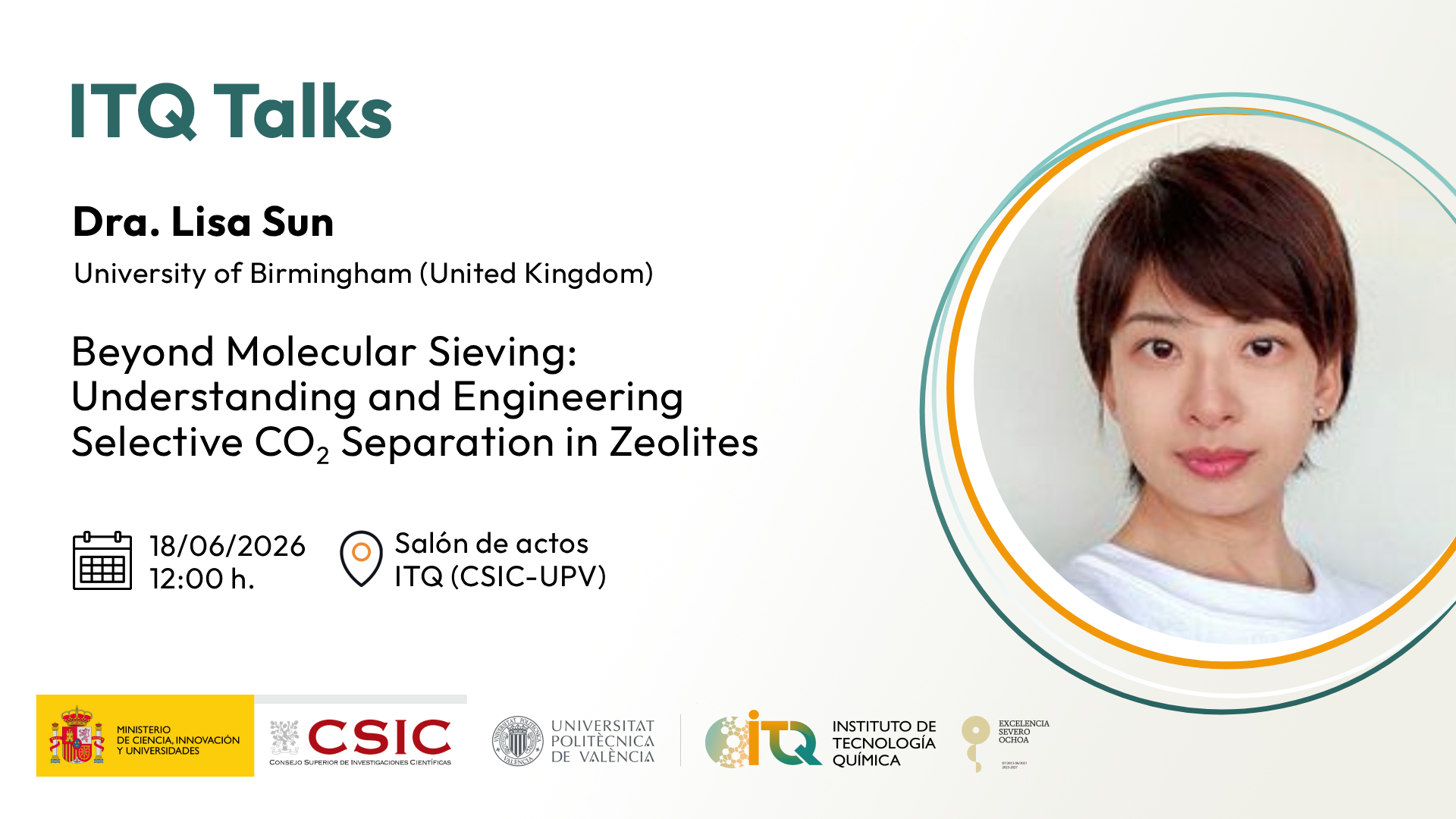
ITQ Talks: Beyond Molecular Sieving: Understanding and Engineering Selective CO2 Separation in Zeolites – Dra. Lisa Sun
En esta jornada ITQ Talks contaremos con Dra. Lisa Sun, Assistant Professor in Energy at the School of Chemical Engineering, University of Birmingham (United Kingdom).
La Dra. Lisa Sun impartirá la charla “Beyond Molecular Sieving: Understanding and Engineering Selective CO2 Separation in Zeolites”.
- 18 de junio de 2026 (12:00h)
- Salón de Actos del ITQ (CSIC-UPV)
Beyond Molecular Sieving: Understanding and Engineering Selective CO2 Separation in Zeolites
Selective separation of carbon dioxide from gas mixtures remains a critical challenge for carbon capture, natural gas upgrading, and sustainable industrial processes. Zeolites have long been regarded as promising adsorbents due to their tunable pore structures, high thermal stability, and strong interactions with quadrupolar CO2 molecules. Traditionally, gas separation in zeolites has been interpreted through the concept of molecular sieving, where separation is governed primarily by the relative size of gas molecules and pore apertures.
This presentation revisits the fundamental mechanisms governing selective CO2 adsorption and separation in zeolites through two complementary studies. The first investigates transition metal cation-exchanged SSZ-13 zeolites, demonstrating how the nature of exchanged cations influences adsorption energetics, framework interactions, and CO2/N2 separation performance. The second challenges the conventional understanding of classical 3A zeolites by revealing that selective gas admission in potassium and sodium ion-exchanged LTA zeolites (Si/Al=1 and 2) is controlled by a dynamic molecular trapdoor mechanism rather than static pore-size exclusion. Combining adsorption measurements with in situ structural characterization, the work provides direct evidence that gas molecules can induce reversible cation displacement to access otherwise inaccessible pore systems.
Together, these studies highlight the critical role of extra-framework cations in regulating adsorption selectivity and demonstrate how dynamic host–guest interactions can be exploited to design next-generation adsorbents. The findings provide new insights into the relationship between pore architecture, cation chemistry, and molecular transport, offering guidance for the rational development of advanced materials for carbon capture and gas separation applications.
Dra. Lisa Sun
Dra. Lisa Sun is an Assistant Professor in Energy at the School of Chemical Engineering, University of Birmingham, United Kingdom. She received her PhD from City University of Hong Kong and subsequently held research positions at Hong Kong Polytechnic University, Imperial College London, and Surface Measurement Systems (SMS), where she worked at the interface of adsorption science, advanced characterisation, and industrial innovation.
Her research focuses on porous materials for gas adsorption and separation, carbon capture, direct air capture, adsorption cooling, and operando characterisation techniques. Dra. Sun has authored more than 30 peer-reviewed publications and holds multiple patents in adsorption and separation technologies. She serves as Deputy Editor of Carbon Capture Science & Technology and is actively involved in several international research collaborations spanning academia and industry.
Her current work aims to bridge fundamental adsorption mechanisms with practical engineering solutions for carbon capture, clean energy, and environmental sustainability