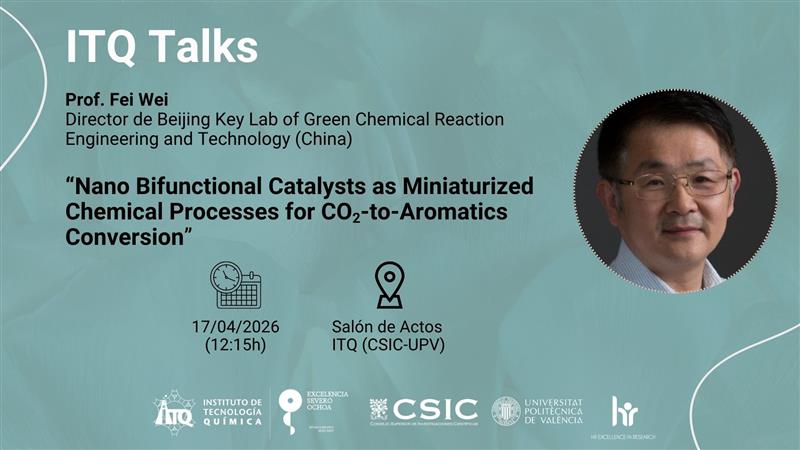
ITQ Talks: Nano Bifunctional Catalysts as Miniaturized Chemical Processes for CO2‑to-Aromatics Conversion – Prof. Fei Wei
En esta jornada ITQ Talks contaremos con el Prof. Fei Wei, Director de Beijing Key Lab of Green Chemical Reaction Engineering and Technology, China.
El Prof. Fei Wei impartirá la charla «Nano Bifunctional Catalysts as Miniaturized Chemical Processes for CO2‑to-Aromatics Conversion»
- 17 de abril de 2026 (12:15h)
- Salón de Actos del ITQ (CSIC-UPV)
Nano Bifunctional Catalysts as Miniaturized Chemical Processes for CO2‑to-Aromatics Conversion
Modern catalysis has traditionally focused on the optimization of isolated active sites; however, industrial-scale chemical manufacturing relies on the integration of reaction, transfer, separation, and feedback operations. The disconnection between these two disciplines catalysis and process engineering creates a fundamental gap between molecular precision and process efficiency. Bridging this gap requires reimagining the catalyst not as a static reactive surface, but as a nano miniaturized chemical process, where sequential unit operations are spatially and kinetically coordinated within a single material framework.
Consequently, achieving such process intensification at the catalytic scale represents one of the frontier challenges in sustainable chemistry and materials design. Bifunctional and multifunctional catalysts provide an effective platform for this translation of process logic into nanoscale architectures. By assigning different catalytic domains to distinct elementary operations activation, transfer, and transformation these systems can emulate the functional synergy of macroscopic chemical plants within confined spatial dimensions. Conceptually, this strategy parallels reaction−transfer−separation−rereaction in chemical-engineering, compressing these steps into a single composite catalyst. The resulting complexity, however, introduces new scientific questions: how can multiple reaction domains communicate, balance kinetics, and sustain cooperative efficiency while preserving thermodynamic directionality?
This talk summarizes our efforts to address these challenges through the rational design of process-coordinated CO2 conversion catalysts. Three representative strategies are highlighted: (i) engineering the activation−hydrogenation unit through atomic-level dispersion and Fe−Fe bond-length tuning to optimize upstream reactivity; (ii) regulating intermediate transfer using a bioinspired catalytic shunt mechanism that controls adsorption strength and pathway branching; and (iii) achieving kinetic synchronization between domains via valence-state modulation to match intermediate formation and transformation rates. Together, these strategies define an integrated framework for nanoscale process intensification, transforming the catalyst into a self-regulating microreactor that mimics the logic of chemical process units. Looking forward, the concept can be extended to hierarchically coupled, dynamically adaptive systems where artificial intelligence and machine-learning-assisted design enable data-driven discovery, real-time feedback, and autonomous optimization ushering in intelligent catalysts that unify reaction and process engineering at the molecular scale.
Prof. Fei Wei
Director of Beijing key lab of green chemical reaction engineering and technology, Fei Wei obtained his PhD in chemical engineering from China University of Petroleum in 1990. After a postdoctoral fellowship at Tsinghua University (China), he was appointed an associate professor in 1992 and professor of chemical engineering of Tsinghua University (China) in 1996. His scientific interests are technological applications of chemical reaction engineering, catalysis, multiphase flow, carbon nano materials, and sustainable energy. He has designed and successfully running over 30 industrial fluidized bed reactors, and authored four books and over 600 refereed publications including 4 papers in Science and Nature, with more than 70000 citations with H index 116.