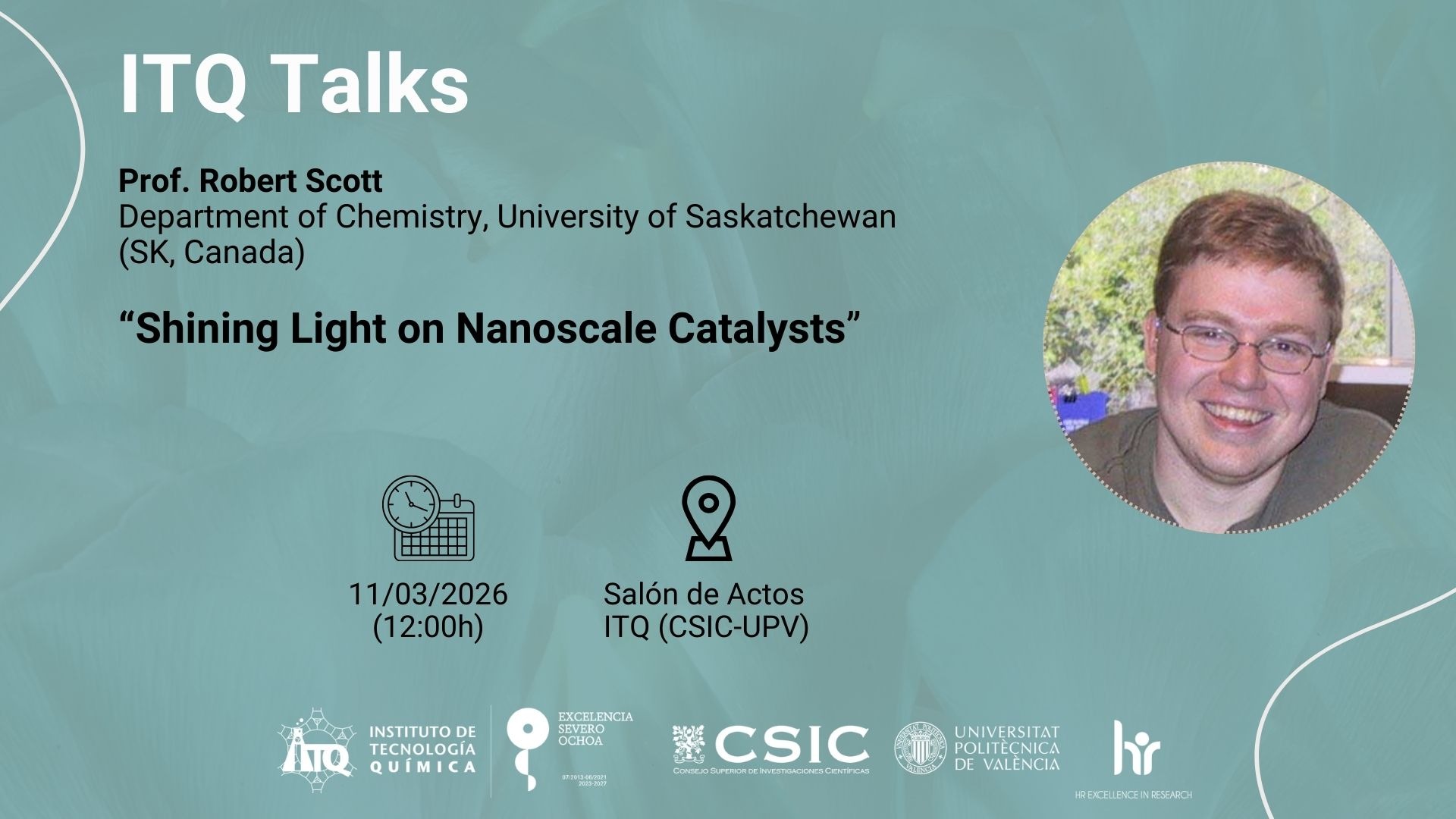
ITQ Talks: Shining Light on Nanoscale Catalysts – Prof. Robert Scott
En esta jornada ITQ Talks contaremos con el Prof. Robert Scott, Department of Chemistry, University of Saskatchewan, SK, Canadá.
El Prof. Robert Scott impartirá la charla «Shining Light on Nanoscale Catalysts»
- 11 de marzo de 2026 (12:00h)
- Salón de Actos del ITQ (CSIC-UPV)
Shining Light on Nanoscale Catalysts
Palladium (Pd) nanostructures are ubiquitous catalytic systems, playing a crucial role in a wide range of industrial and environmental processes. In this talk I will highlight our recent work following the chemistry of Pd nanoclusters and nanoparticles during their use as C-C coupling, hydrogenation, and methane oxidation catalysts. The structural transformations of Pd nanocatalysts were followed using a combination of in-situ techniques such as X-ray absorption spectroscopy (XANES and EXAFS) and pair distribution function (PDF) analysis of high energy total X-ray scattering data at the Canadian Light Source.
In the first part of this talk, [Pd3(μ-Cl)(μ-PPh2)2(PPh3)3]+ nanoclusters are used for atypical cross-coupling reactions of polyhalogenated heteroarenes. In situ liquid EXAFS characterization, coupled with ex situ mass spectrometry results, allows for the generation of structure/selectivity relationships in these catalysts, and highlights how reaction conditions (base, temperature) influence the stability of the Pd3 nanoclusters. In addition, I will show how the Pd3 nanoclusters can be activated onto support surfaces via removal of the phosphine ligands and converted into true heterogenous catalysts. In situ PDF analyses complemented by EXAFS data were used to optimize the thermal activation of the nanoclusters. The resulting activated catalysts are exceptionally active for selective hydrogenations of alkyne substrates. Finally, I will move to the use of PDF analyses to probe the medium range order in supported Pd nanoparticles, information that is inaccessible by either EXAFS or XRD. Specifically, I will show how tensile strain affects the chemistry of Pd nanoparticles, such that oxidation to the active PdO phase for methane oxidation can only occur when the tensile strain in the nanoparticles has been alleviated.
Prof. Robert Scott
Robert Scott is a Professor of Chemistry at the University of Saskatchewan. He received his Doctor of Philosophy (Ph.D.) degree in Chemistry at the University of Toronto in 2002, which was followed by a postdoctoral fellowship at Texas A&M University. He began his independent career at the University of Saskatchewan in 2005.
Prof. Scott’s work focuses on the rational design of nanoscale heterogeneous catalysts through bottom-up synthetic approaches that involve making well-defined nanoparticles and clusters followed by activating them on supports. He has particular interest in the design of selective hydrogenation and oxidation catalysts. His group has developed expertise in X-ray absorption spectroscopy and high energy scattering experiments at the nearby Canadian Light Source to characterize the short and medium range order of nanoscale catalysts via EXAFS and pair distribution function analyses. This work has led to the development of a range of in situ and operando setups that allow the interrogation of catalyst speciation for both liquid phase and high-temperature reactions of gases over solid heterogenous catalysts.